
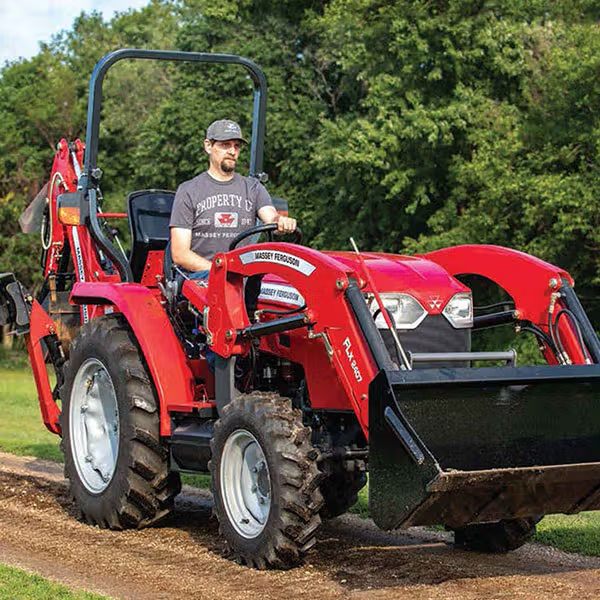

Running a smaller property doesn’t mean settling for less capable equipment. The challenge is finding machines that fit the scale without compromising on what actually needs to get done. Too often, people either over-invest in gear that’s overkill for their needs, or they go too small and end up frustrated when simple tasks take all day.
The answer lies in the middle. Get equipment with the proper amount of horsepower—and implements—so that they match the work that needs to be done, but also have sufficient versatility to accommodate the multitude of jobs typically required on a smaller acreage.
Why Size Matters More Than You’d Think
The issue with compact equipment is that when it’s designed properly, it can do a lot more than one would ever expect. A tractor or utility machine of the right size can travel to appropriate areas, use less fuel, and support enough functionality needed on a daily basis. The issue comes when someone buys too much machine for what’s expected on a week-to-week basis by way of price or availability.
There’s a lot more maneuvering to do on smaller properties. You’re getting in and out of barns and sheds, through gates and fence lines, and into spaces that are too tight for a larger machine to either maneuver or gain access without destroying landscaping or fields. Equipment that’s sized properly with good power-to-weight ratios are easily utilized by all and most people fail to recognize how much time they waste trying to force equipment that is too big, only realizing once it’s time to downsize.
Versatility Makes All the Difference
The best compact equipment is that which boasts too many jobs without attacher swaps or hefty adjustments. The reason this is important is because smaller operations rarely have the luxury of using dedicated machines for every single job. Therefore, options that allow for quick changes in mindset—from mowing to loading to grading, etc.—make day-to-day efficiency much better and allows for more productivity.
Modern compact tractors are no longer just for your backyard landscaping, but rather, legitimate workhorses. Many newer models boast true hydraulic capacity, substantial three-point hitches and safety which allow for front end loaders without tipping them over. Anyone who lives in an area with good agricultural supply chains can see that Kubota Perth WA options show how current compact trends are now real farm equipment.
What separates good versatile workhorses from poor quality machines lies in the ability for good engineering to support a range of attachments and other uses. Many people tout versatility only to render machines incapable of anything beyond their main purpose. However, strong machines remain functional from start to finish.
Fuel Use and Overall Costs
Smaller engines equal better fuel usage which accumulates over time as months turn into years of operation. However, better expense management comes from proper sizing of a machine for the job; there’s no need to operate a 70-horsepower tractor for 30 horsepower-worthy work. Running bigger machines requires more fuel and even excess wear on parts which are working harder than they need to.
In addition, while maintenance is cheaper in general with appropriately sized machinery, parts are often less expensive, fluid exchanges are less impactful, and general maintenance can be completed without specialized tools. Insurance and storage variables prefer reduced size equipment—especially when shed space is at a premium.
The goal is to find machines that possess appropriate power for peak operations without being excessively oversized for daily appropriate use. Most properties possess one or two really heavy jobs each year and then moderate work throughout the rest of the year. Machines that support both efforts without failing at either end of the spectrum offer the best compromise.
Quality Construction Still Matters
Just because something’s compact doesn’t mean it’s flimsy. The best smaller machinery is developed upon the same principles and construction methods as bigger equipment, sized down accordingly. Look for heavy frames, strong hydraulics and components that don’t sound like they’re experiencing stress at every turn.
Some manufacturers use compact equipment as sub-par constructed entry-level avenues while others bring no nonsense from their larger builds down to size. It’s easy to spot these differences within hours of working. Machines that shake like crazy leak hydraulic fluid after a few uses and have steering play after one season are looking for a builder with longevity.
Pay attention to control feel, transmission smoothness and mounting opportunities for attachments that don’t seem like they might fall off after being secured. If something looks professional-grade or merely kindergarten-level care—which will become frustrating in less than a year—is better assessed before any purchase.
Buy What You Need Instead Of What You Think You Need
The most successful operation on small acreage works with equipment that’s truly suited for how they work. This means assessing what’s regularly done versus occasionally done—those tasks which might help merit renting or sub-contracting out—and utilizing known resources before expecting what could be too much for sub-par options.
For example, working with pastures needs different expectations than something that’s constantly loading or providing groundcover needs. The former needs multiple smaller implements but the latter needs stability even on smaller acreage—and there’s nothing wrong with that.
An issue arises when people buy based upon projected capability versus reality. Equipment that’s capable of 90% of typical work efficiently surpasses what takes an hour just because it could theoretically do everything without making every job unnecessarily difficult.
Making Smarter Equipment Decisions
Get more done by using less when it comes to equipment sized for small properties—but make sure it’s not of less quality! Properly sized compact machinery transforms small properties into well-oiled machines if only operating power, versatility and construction quality adequately support what the compact offers over time. Instead of compensating, not it’s time to realize how reduced size compact equipment isn’t so compromised at all!